Laminating veneer onto plywood, MDF or block board looks simple: apply glue, stack the layers, press. But the type of press you use decides how fast you work, how strong the bond is, how much power you spend and how many rejected boards you throw away.
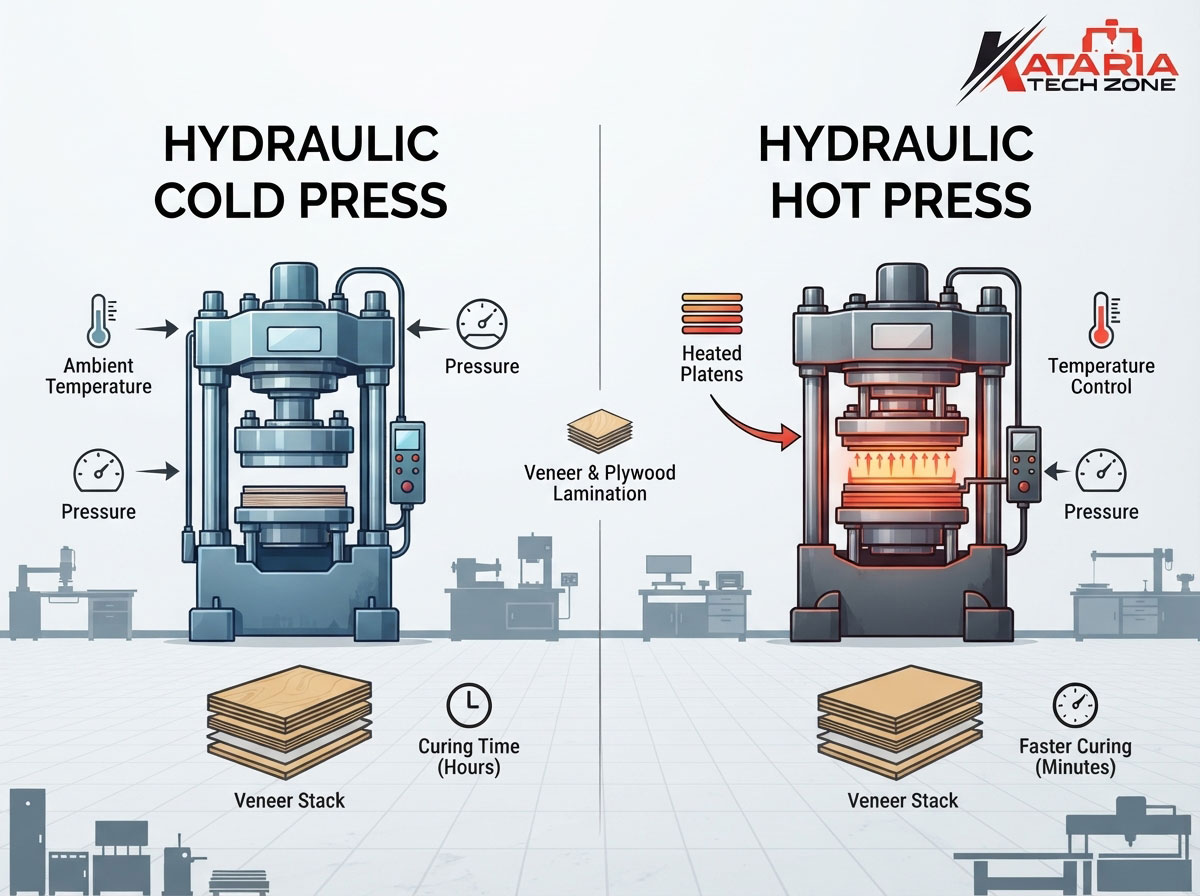
The two main options are the hydraulic cold press and the hydraulic hot press. Both apply heavy, even pressure through hydraulic cylinders. The difference is heat. A cold press works at room temperature, and a hot press uses heated platens to speed up the glue cure.
At Kataria Tech Zone, we help furniture makers, plywood units and interior workshops choose machinery that matches their volume and budget. This guide explains how each press works, where each one wins and how to decide.
How Lamination Pressing Works
Whether you use heat or not, the process has the same three jobs:
- Bring the surfaces into close contact. Veneer and substrate must touch fully with no air pockets.
- Hold pressure while the adhesive sets. Pressure spreads the glue into a thin, even film and keeps the layers from moving.
- Allow the adhesive to cure. Glue chemistry sets the schedule: time, temperature and pressure.
The right press makes sure all three happen uniformly across the whole panel. Weak pressure, uneven heat or a wrong cycle time causes the most common defects: bubbles, delamination, telegraphing and glue bleed-through.
What Is a Hydraulic Cold Press?
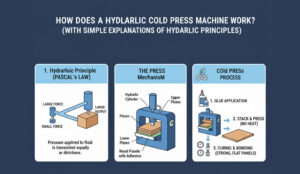
A hydraulic cold press applies high, uniform pressure without heating the platens. The adhesive cures at room temperature, so the panel stays in the press for a longer period.
How it works: Glued layers are stacked between the platens. The hydraulic system closes the press to the set pressure, and the stack is held until the glue has developed enough bond strength.
Typical adhesives: PVA (white glue), some urea-formaldehyde formulations, and cold-setting contact or water-based adhesives.
Common uses:
- Veneering plywood, MDF and particle board
- Decorative laminate work for furniture and doors
- Flush door skins
- Pressing curved or shaped parts with moulds
- Small and medium furniture workshops
If you are new to this technology, read our guide on the key benefits of hydraulic cold press machines in modern woodworking.
What Is a Hydraulic Hot Press?
A hydraulic hot press uses heated platens, warmed by electric heating elements, thermic oil or steam, to accelerate glue curing while pressure is applied. Because heat drives the curing reaction, cycle times drop dramatically.
How it works: Glued layers are loaded between heated platens. Heat and pressure act together, curing the adhesive in minutes rather than the tens of minutes a cold press often needs.
Typical adhesives: Urea-formaldehyde (UF), phenol-formaldehyde (PF), melamine-based adhesives and hot-melt or thermosetting films.
Common uses:
- Plywood manufacturing
- High-volume veneer lamination
- Decorative laminates and high-pressure laminates (HPL)
- Water-resistant and exterior-grade boards
- Continuous production lines
Heated platen temperatures vary with the adhesive and product. Always follow the adhesive manufacturer’s data sheet for temperature, pressure and time.
Key Differences at a Glance
| Factor | Hydraulic Cold Press | Hydraulic Hot Press |
|---|---|---|
| Platen temperature | Ambient | Heated (adhesive-dependent) |
| Cycle time | Longer | Much shorter |
| Production rate | Lower to medium | Medium to very high |
| Initial investment | Lower | Higher |
| Running cost | Low (no heating energy) | Higher (heating energy) |
| Adhesive types | PVA, cold-setting glues | UF, PF, melamine, thermosetting |
| Water resistance | Depends on glue, usually interior | Can achieve high water resistance |
| Best for | Workshops, veneering, shaped work | Plywood mills, high-volume lines |
| Maintenance | Simpler | More complex (heating system) |
| Risk of heat damage | None | Possible on sensitive veneers |
Speed and Productivity
Speed is the biggest difference between the two.
A cold press relies on the glue setting slowly at room temperature, so each load sits in the press for a long period. Workshops often solve this by adding multiple daylight openings or by using more than one press so one loads while another cures.
A hot press cures the glue faster, so each cycle is much shorter. For a plant producing hundreds or thousands of sheets a day, this speed is what makes production viable.
Rule of thumb: If you press a few dozen panels per shift, cold pressing is usually enough. If you press hundreds, a hot press pays for itself through throughput.
Bond Strength and Quality
Both presses can produce excellent bonds when used correctly. The quality difference comes from the adhesive and the process, not just the machine.
Cold press:
- Works very well with PVA and interior-grade adhesives.
- Gentle on the material. There is no heat stress that could dry out or warp veneer.
- Longer press time allows the glue to spread and wet the surfaces well.
Hot press:
- Heat lets thermosetting adhesives cross-link fully, giving stronger and more water-resistant bonds.
- Faster cure reduces the chance of glue soaking through thin veneers, though too much heat or moisture can cause other problems.
- Suited for marine, exterior and structural plywood.
For interior furniture, a well-run cold press delivers durable results. For products exposed to humidity, heat or structural loads, a hot press with the correct adhesive is usually the right choice.
Veneer Types and Sensitivity
Not all veneers behave the same under heat.
- Thin, delicate or figured veneers (burr, crotch, highly figured woods) can dry, curl, crack or discolour under heat. A cold press is safer.
- Standard sliced veneers on plywood or MDF work well in both.
- Reconstituted veneers and decorative papers usually suit hot pressing.
- Oily or resinous woods such as teak can affect glue bonding in either process, so test first.
If you work with premium decorative veneers where appearance is everything, the gentler cold press is often the lower-risk choice.
Cost: Purchase Price vs. Running Cost
Purchase price: A cold press generally costs less than a hot press of similar size because it has no heating system, thermal insulation, temperature controls or cooling.
Running cost: A cold press uses electricity only for the hydraulic pump. A hot press adds the energy to heat platens, whether electric, thermic oil or steam, plus more maintenance on the heating system.
The real question is cost per finished panel. A hot press with higher running costs can still be cheaper per panel if its speed lets you produce far more boards per day. To go deeper on this, read our guide on calculating total cost of ownership for CNC machines. The same thinking applies to any machine.
Adhesive Compatibility: Choose the Glue First
A frequent mistake is buying the press first and choosing the glue second. Do it the other way round.
- PVA and cold-setting adhesives are designed for cold pressing.
- UF and PF resins typically need heat to cure properly and quickly.
- PUR and hot-melt systems have their own temperature and moisture requirements.
Ask your adhesive supplier for the recommended pressure, temperature and time. That information tells you which press type suits your product.
Pressure, Platen Size and Flatness
Whichever press you choose, three specifications matter:
1. Pressing force and pressure distribution. Check that the machine can deliver the required pressure across the entire platen area. Weak or uneven pressure is the main cause of bubbles and delamination.
2. Platen size. Match the platen to your standard sheet sizes. For plywood sheets, this usually means large platens with multiple openings.
3. Platen flatness and parallelism. Uneven platens cause uneven glue lines and thickness variation. In hot presses, uniform heat across the platen matters too.
If bubbles are a recurring problem, see our guide on preventing air bubbles and delamination in cold press lamination.
Common Problems and Which Press Helps
| Problem | More common in | Typical cause |
|---|---|---|
| Air bubbles | Both | Uneven pressure, poor glue spread |
| Delamination | Both | Wrong glue, low pressure, short cycle |
| Glue bleed-through | Hot press, thin veneer | Too much glue, high heat |
| Veneer cracking or curling | Hot press | Excess heat or moisture loss |
| Long waiting time | Cold press | Slow cure at room temperature |
| Warping of panels | Both | Uneven moisture, cooling too fast |
Which Press Should You Choose?
Choose a Hydraulic Cold Press if:
- You run a furniture workshop or interior fit-out business.
- You work with decorative or delicate veneers.
- You want a lower purchase price and lower running costs.
- You use PVA or cold-setting adhesives.
- Your daily volume is small to moderate.
- You also press shaped or curved parts using moulds.
Choose a Hydraulic Hot Press if:
- You produce plywood or laminated boards in volume.
- You need water-resistant or exterior-grade bonds.
- You use UF, PF or melamine adhesives.
- You need short cycle times to hit output targets.
- You have the power supply, space and skilled staff to maintain a heated system.
Consider both if:
Many plywood manufacturers cold pre-press sheets first to hold layers in place and remove air, then finish with a hot press. Some workshops keep a cold press for delicate veneer work and add a hot press as demand grows.
Where Your Press Fits in the Workflow
Pressing is only one step. Quality depends on what happens before and after:
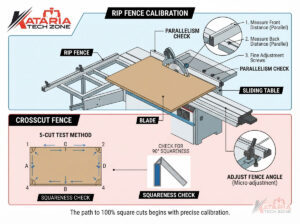
- Cutting panels accurately with a well-calibrated saw. See our guide on calibrating sliding panel saw fences for square cuts.
- Shaping and cutting components with a CNC router. Learn more in our beginner’s guide to CNC routers for woodworking.
- Finishing edges with an edge banding machine so laminated boards look complete.
- Planning your expansion by reading top machinery upgrades every woodworking business needs to scale production.
A well-chosen press works best inside a well-planned production line.
Best Practices for Either Press Type
- Keep the substrate and veneer at stable moisture content. Too wet or too dry causes warping and bond failure.
- Apply glue evenly with a roller or spreader, and use the recommended spread rate.
- Stack layers carefully so the veneer is aligned and free of dust.
- Follow the adhesive data sheet for pressure, time and temperature.
- Check platen cleanliness and flatness regularly.
- Use cauls or pressing sheets to protect the surface and spread pressure.
- Let panels rest after pressing so moisture and stress settle before machining.
- Test on scrap first when changing veneer, glue or settings.
Frequently Asked Questions
What is the main difference between a cold press and a hot press?
A cold press works at room temperature and relies on the glue setting over time. A hot press heats the platens to cure the adhesive much faster.
Which is better for veneer lamination?
For delicate decorative veneers and small to medium volumes, a cold press is often the safer choice. For high-volume veneer and plywood production, a hot press is usually more efficient.
Can I use PVA glue in a hot press?
Generally PVA is designed for cold pressing, and heat can cause problems. Check the adhesive data sheet before using it in a hot press.
Is a hot press more expensive than a cold press?
Usually yes, in both purchase price and running cost. The higher speed can lower the cost per panel in high-volume production.
Can I start with a cold press and upgrade later?
Yes. Many workshops begin with a cold press and add a hot press as production grows. Some plants use both in one line.
How long should panels stay in a cold press?
It depends on the adhesive, veneer, temperature and pressure. Always follow the adhesive manufacturer’s recommendation.
What causes bubbles in laminated panels?
Uneven pressure, poor glue spread, trapped air or moisture problems. Check pressure distribution and platen flatness first.
Final Thoughts
There is no single winner between hydraulic cold presses and hot presses. Each is the right tool for a different job.
A cold press gives you lower cost, gentle handling and flexibility, which suits furniture workshops and decorative veneer work. A hot press gives you speed, stronger and more water-resistant bonds, and the throughput that plywood production demands.
Start with your adhesive, product type, daily volume and budget, then choose the press that fits. Get that match right and you reduce rejects, save time and produce cleaner, stronger laminated boards.
At Kataria Tech Zone, we supply woodworking and CNC machinery for workshops of every size. Browse our full machinery range, read more practical guides on our blog or contact our team for help choosing the right lamination press for your production needs.